They arrived at half past three in the afternoon. I knew they were coming before the nurse announced them, not because I'd heard the footsteps in the corridor but because I'd caught their scent from three floors away — a warm animal smell, like a dog that had been running hard and was still warm from the exertion. It cut through the antiseptic hospital smell like a blade through gauze, and my body responded before my mind could catch up: my pulse jumped, my throat constricted, and something in my chest pulled tight like a rope being drawn through a block.
The nurse stood in the doorway. "You have visitors," she said, and her voice had changed since the night nurse's shift. Colder. More careful. "They say they're here about you."
I sat up in bed. The movement felt easier than it had on day one — still wrong, still slow, but with an underlying efficiency that suggested my body was learning its new dimensions, adjusting to whatever it had become. "Who are they?"
"Family," the nurse said, with a pause that made the word sound like a question.
It wasn't. I understood that immediately. Whoever they were, they weren't family. They were something else — something that had decided, without consulting me, that I belonged to whatever category they occupied.
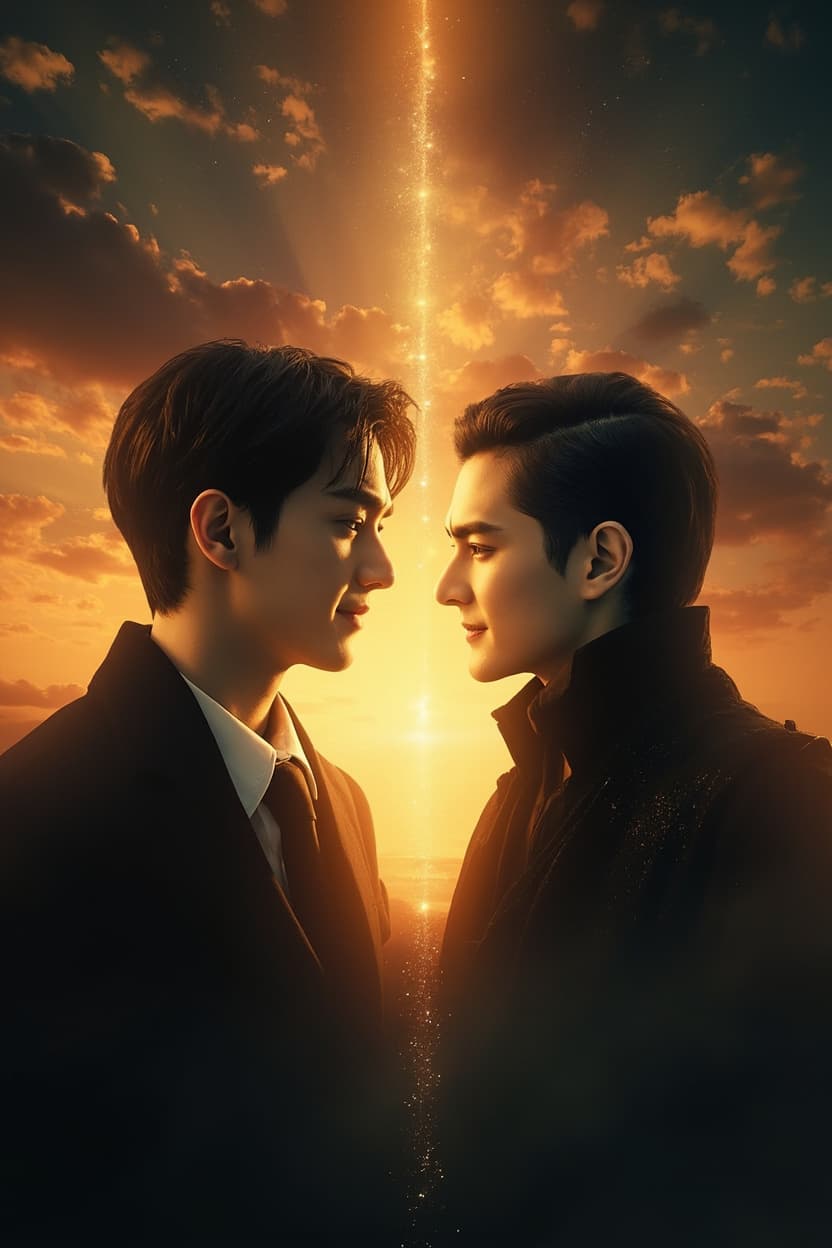
Two men stepped into the room.
The first was tall, broad-shouldered, with dark hair cut short and a jaw that looked like it had been designed for the purpose of setting lines at a particular angle. He moved into the room like he owned it — not aggressively, but with the absolute confidence of someone who had never encountered a space that wasn't his to enter. He wore a flannel shirt and work boots and jeans, and he smelled of the running-animal-warmth and something else beneath it, something sharper, like ozone before a storm.
The second man was shorter, leaner, with darker skin and eyes that moved constantly, cataloguing everything in the room with the quick efficiency of a bird or a hound. He had the same jaw structure as the first man — family, then, or something that wore family resemblance like a uniform. He was wearing a dark coat and he hadn't taken his eyes off me since he entered, as though I were a puzzle he was working through.
The first man spoke. "Wren."
Not a question. My name, delivered like a statement of confirmed identity.
"That's what they're calling me," I said.
"And you're not sure it's yours."
"No."
He nodded, as though this were the answer he'd expected. He pulled the visitor's chair around — the same chair the night nurse had sat in, though this man moved it with a different quality of purpose, the deliberate repositioning of someone who wanted to see and be seen from a particular angle.
"My name is Damon Prado. This is my cousin Mateo. We're here on behalf of Rafael Vega, who is the alpha of the Thornwood Pack." He paused, watching my face for a reaction. There was nothing to react to; I didn't know what an alpha was, or a pack, or what any of this meant. "You've been on our territory for four days. That makes you our concern until we understand what you are."
"What I am," I repeated.
"You don't know," Mateo said. He hadn't sat down. He was standing slightly behind and to the left of Damon, positioned like a support beam, and his voice was lighter than Damon's — almost musical, with an undertone of something that might have been amusement or curiosity. "That's interesting. Most people who wake up in a hospital know what they are, even if they don't want to say it."
"I'm not most people."
"No," Damon said. "You're not."
He leaned forward in the chair. The movement brought him closer to the bed, and the smell of him intensified — all that animal warmth, that running-heat, and beneath it something that made my throat close and my jaw tighten and my hands grip the plastic rail of the bed with a force that made the plastic creak.
"We know what you are," Damon said. "We smelled it the moment we walked in. But what we can't figure out is why you're here, in Keswick, on our land, with no memory of how you got here. That's a lot of coincidence."
"I don't know why I'm here."
"Then let me offer you a possibility." Damon's voice had dropped, gone lower, more resonant, as though it were coming from somewhere deeper in his chest. "You were brought here. By someone, or something, that wanted you out of the way. And the accident that put you in this hospital wasn't an accident at all — it was a disposal. Someone put you on a road and waited for the cars to come, and you were lucky enough to survive."
"Lucky," I said.
"Or unlucky. Depending on how you look at it."
Mateo moved. He came around the foot of the bed and sat on the edge of the chair Damon had vacated, crossing one leg over the other, his posture loose but his eyes still fixed on me. "You haven't eaten anything," he said. "We've checked with the staff. Three days, and you haven't touched solid food. You drink juice and water and that's all. Why?"
The question hit the same note as the night nurse's — that same precision, that same sense of knowing exactly what they were asking and knowing I wouldn't want to answer it. I looked at Mateo and felt the pull of his scent again, that warm animal smell, and beneath it something different now that he was closer. A complexity. Layers. The ozone-sharpness Damon had carried, but also something sweeter, almost floral, like crushed leaves.
"I don't want it," I said. "The food. I can smell it and I know it's food but it doesn't feel like something I can eat."
"What does it feel like?" Mateo asked. He leaned forward slightly.
"Like looking at a picture of something. Not the thing itself."
Mateo and Damon exchanged a look. The look said: we were right. The look said: it's worse than we thought.
"The hunger you're not feeling," Damon said slowly, "it's not for food. You know that, don't you? Even if you don't know what you are, some part of you knows what you need."
My throat closed tighter. The pull I'd been feeling since they entered the room intensified — not just the scent of them, not just the warm-animal smell, but something beneath it. A frequency, a signal, a specific and unmistakable call. Blood. Not the abstract concept of it but the real thing, moving through their bodies, close to the surface of their skin, right there, right behind the thin membrane of their veins.
I stood up.
The motion surprised all three of us — me, Damon, Mateo — and for a moment we were all frozen in the geometry of it: me standing beside the bed in my hospital gown, my bare feet on the cold floor, Damon half-risen from his chair, Mateo's eyes wide with something that might have been delight or alarm.
"Where are you going?" Damon asked.
I didn't know. I was standing because my body had decided to stand, because the need that had been building in my chest had found its direction and my legs had followed. The window. No. The door. No. I was moving toward something and away from something at the same time, pulled by the scent of them and pushing against it, trapped between two forces that were both pointing in the same direction.
"Sit down," Damon said. His voice had changed. Harder. More layered, with a resonance that seemed to press against my ears from the inside. "You need to stay in control. Whatever you're feeling right now, you need to manage it."
"I don't know how."
"Then let us help you."
He stood too. The room had contracted around us — the monitors, the drip stand, the bed with its rumpled sheet — and in the centre of this contracted space, Damon was looking at me with an expression I couldn't read. Not anger. Not fear. Something more complicated, something that contained calculation and something else, something warmer, that he was trying to keep separate from the calculation.
"You are a vampire," he said. "You are Sanguis lamia — the blood-drinking dead. You've been in that bed for four days and your body has been sustaining itself on nothing, which means you are weaker than you should be, and you are more dangerous than you should be, and the thing that's pulling at you right now — the hunger — is going to get worse before it gets better."
The word landed in my chest like a stone in water. Vampire. I knew the word. I knew what it meant. I knew it the way I knew Keswick — from context, from reading, from the accumulated cultural sediment of stories and films and half-remembered myths. But knowing the word and understanding that it applied to me were two different things, and the distance between them was vast enough to fall into.
"I don't believe you," I said.
"You don't have to believe me. The hunger is real whether you believe in it or not." Damon took a step toward me. "The question is what you do about it. And the answer is — you come with us. Now. Today. Because in about six hours, the hunger is going to break through whatever walls you've built around it, and when that happens, you'll be in a hospital full of people whose blood smells like the sweetest thing you've ever encountered, and none of us want to find out what happens after that."
Mateo stood too. He was behind me now — I could feel his warmth at my back, smell the layered complexity of his scent, and the combination of the two wolves, one in front and one behind, was almost unbearable. Not threatening, exactly. But complete. Like being held in a frame.
"Rafa wants to meet you," Mateo said softly. "He'll know what to do. He always knows what to do."
"Rafa," I said.
"Our alpha," Damon said. "The man who runs this pack. The man who is going to decide what happens to you, starting the moment you walk out of this hospital."
My throat was burning. Not the sharp burn of infection or illness but something deeper, something that felt like the inside of my oesophagus was being drawn closed by invisible thread. The wolves' blood was so close. Right there, beneath their skin, in the vessels that ran through their bodies like a second architecture. I could almost taste it — not the taste itself but the idea of it, the memory of it, the shape of a need I didn't remember having until now.
"The hospital," I said. My voice came out strange, rougher than before. "The people here. If I'm what you say I am, what happens to them?"
"Nothing," Damon said. "If you come with us now."
"And if I don't?"
Mateo answered. "Then in about six hours, you'll find out what happens when a starving vampire loses control in a building full of humans. And none of us — none of us — want that answer."
The monitor was still beeping. My heart rate, which had been 44 and steady, was now 68 and climbing. I could hear it in the beep — faster, more insistent, a rhythm trying to outpace the hunger that was trying to consume it.
I sat back down on the bed.
The plastic rail pressed into my thigh. The cold floor pressed into the soles of my feet. The wolves watched me, waiting, their scents filling the room like weather.
"I can't stay here," I said.
"No," Damon agreed. "You can't."
Outside the window, the car park lights had come on. It was getting dark. The rain had started again, a thin grey mist that blurred the edges of everything, and in the half-light the wolves looked less like men and more like something else — something older, something that had always been there, waiting in the dark at the edges of human places.
"Six hours," I said. "You said six hours."
"We were being generous," Mateo said. "More like four."
I looked at the window. The rain. The lights. The blurred shapes of cars and people moving through the car park, going home from work, thinking about dinner and television and the small ordinary concerns of ordinary lives. None of them knew what I was. None of them knew what was in this room with them.
"Tell me what to do," I said.
Damon pulled his phone from his pocket. He pressed a button and held it to his ear, and I heard it ring once before someone answered, and then he said: "We've got him. We're bringing him in. Tell Rafa to clear a room."
The line went dead. Damon put the phone away. He reached down and offered me his hand — large, warm, with short nails and calluses that suggested physical work. The hand of someone who used his body for things that mattered.
I took it.
His skin was very warm. The contact sent a shock through me — not the hunger, which was still there, still pulling, but something else beneath it. A recognition. A small click of something fitting into place.
He pulled me to my feet. I was taller than him by an inch or two but he still managed to make the motion feel like he was helping me up rather than pulling me up, like he was being careful with something fragile.
"There's a back exit," he said. "We'll go out that way. Mateo will drive. You sit in the back and keep your mouth closed and your eyes open, and if you feel the hunger starting to break through, you tell us immediately. Understood?"
"Understood."
He led me to the door. Behind me, Mateo was already moving, already talking quietly into a phone, arranging whatever needed to be arranged. I followed Damon into the corridor, past the nurses' station, past a doctor who looked up and then looked away very quickly, and I understood that someone had spoken to the staff, someone had explained that whatever was happening in room 412 was above their pay grade, and they had agreed to look the other way.
The back exit was a fire door at the end of a service corridor. It opened onto a loading bay behind the hospital, where the rain was heavier and the air smelled of wet concrete and diesel and, faintly, something green — grass, or leaves, or the hillside beyond the car park.
Mateo's car was a dark SUV parked at an angle, as though it had arrived fast and stopped fast. He opened the back door and I got in, sliding across the leather seat, and Damon got in beside me, and the door closed, and the sound of the rain became muffled and distant, a background noise rather than a presence.
Mateo started the engine. The car pulled out of the loading bay and onto the road, and I watched the hospital shrink in the side mirror — the grey building, the lit windows, the ordinary world I was leaving behind.
"Your wrist," Damon said.
I looked down. The scar. I'd been touching it again without realising, rubbing the thin pale line with my thumb.
"What happened to it?" he asked.
"I don't know."
"Whoever did it knew what they were doing. That's not a wound — that's a marker. Some kind of ritual cut." He paused. "We're going to find out what it means. But not tonight."
Tonight was for getting me somewhere safe. Tonight was for meeting Rafa. Tonight was for surviving the next four hours without the hunger breaking through, and I could feel it already — pressing at the edges of whatever walls I'd built around it, testing for weaknesses, preparing its assault.
The car moved through the darkening Lake District. Hills appeared on either side, green and grey and silver in the failing light. The road was narrow and winding and Mateo drove it with a confidence that suggested he knew every corner, every camber, every dip and rise, the way a person knows their own body.
I watched the hills go by. I listened to the tyres on the wet road. I felt the wolves on either side of me — Damon's warmth to my right, Mateo's cooler presence up front — and the hunger coiled in my chest like something alive, and I understood that everything that was about to happen would be because of this: because I was a vampire, and I was starving, and the only thing between me and catastrophe was a car with two wolf-shifters who had decided, for reasons I didn't yet understand, to take me home.